
When you start looking into a new CCTV system for your business, it’s easy to focus on the price of the cameras. But that’s only one part of the puzzle. The real commercial CCTV system cost includes the hardware, the expert installation, and any ongoing services you’ll need.
For a professional setup here in the UK, you could be looking at an investment anywhere from £1,200 to over £50,000. The final figure really depends on the size of your site and how sophisticated you need the security to be.
What Does a Commercial CCTV System Really Cost?
Thinking about the cost of a commercial CCTV system is a bit like buying a new van for the business. The sticker price is just the starting point. You also have to factor in fuel, insurance, and regular servicing to get the full picture.
In the security world, we call this the Total Cost of Ownership (TCO). It’s the only way to get a realistic forecast for your budget, avoiding any nasty surprises down the line. Instead of one single price, it’s much clearer to break the investment down into three core pillars. This helps you see exactly where your money is going and why each part is crucial for a system that actually works when you need it.
This simple breakdown shows the three main cost areas.
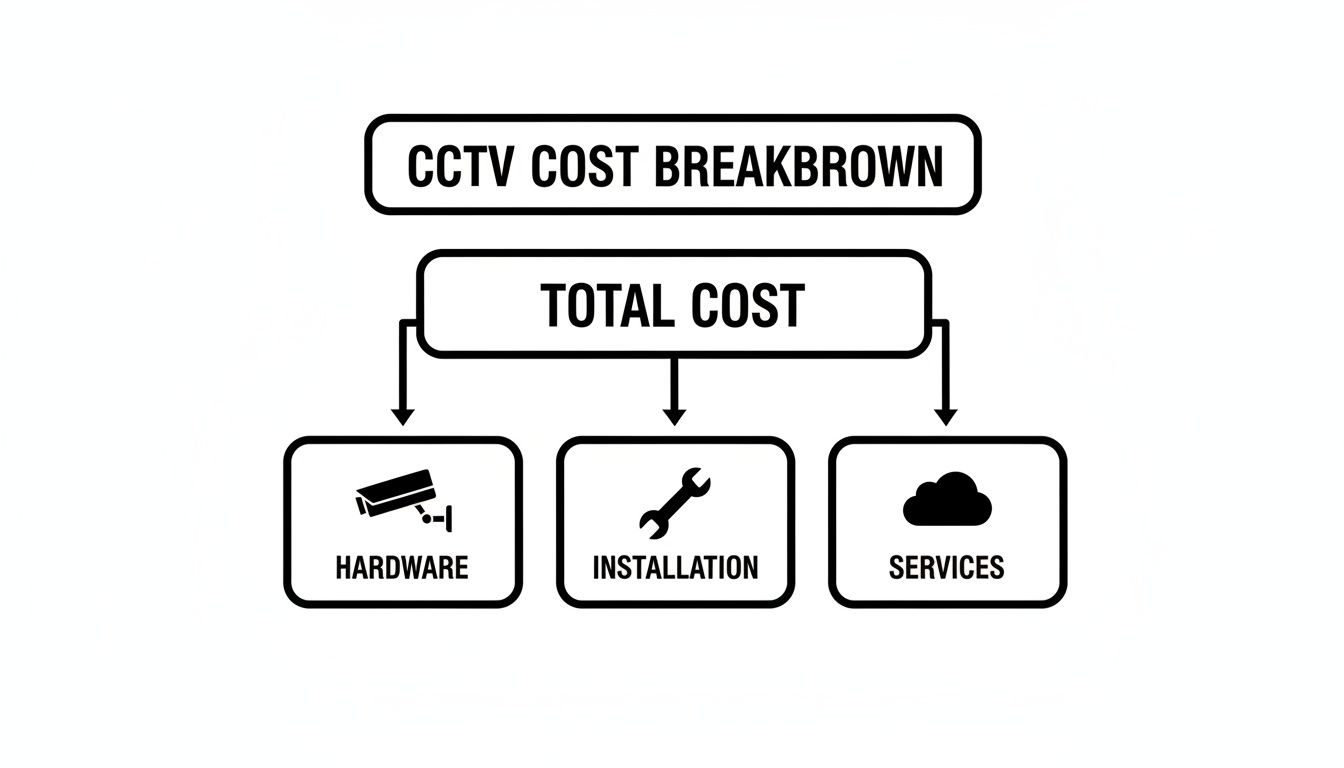
As you can see, a solid security budget has to cover the physical kit, the skilled labour to install it, and the long-term support that keeps it effective.
The Three Pillars of CCTV Costs
To budget properly, you need to think about these three distinct areas:
- Initial Hardware Investment: This is the most obvious part of the cost. It includes the cameras themselves, the recorder (an NVR or DVR), the hard drives for footage storage, and all the cabling and connectors.
- Professional Installation: This covers the time and expertise needed to mount cameras in the right spots, run cables discreetly, connect everything to your network, and get the system configured for peak performance.
- Ongoing Services and Maintenance: This pillar covers recurring costs. Think remote monitoring services, cloud storage plans, software updates, and annual maintenance agreements that keep everything secure and in perfect working order.
Trying to cut corners on any one of these can backfire badly. You might end up with unexpected bills or, worse, a system that fails at the critical moment.
For example, a basic four-camera commercial system in the UK typically costs between £1,200 and £2,000 for the equipment and professional installation. Our experience shows that trying to go cheaper often leads to major security blind spots and unreliable hardware. You can learn more about how UK security costs are calculated on SSY Group’s website.
Understanding the Total Cost of Ownership prevents the common mistake of underinvesting. A cheap initial purchase can quickly become expensive through unreliable performance, frequent repairs, and unforeseen upgrade requirements.
To give you a clearer idea of what to expect, the table below shows some typical all-in price ranges for different-sized businesses in the UK. These figures cover the initial hardware and professional installation, which we’ll break down in more detail next.
Estimated Commercial CCTV System Cost at a Glance
| Business Size | Typical Camera Count | Estimated Installed Cost Range |
|---|---|---|
| Small Business | 4 – 8 Cameras | £1,200 – £3,500 |
| Medium Business | 8 – 16 Cameras | £3,000 – £8,000 |
| Large Business | 16+ Cameras | £7,500 – £50,000+ |
These figures provide a solid baseline. The final cost will always depend on your specific needs, the type of equipment you choose, and the complexity of your site.
Breaking Down Your Initial Hardware Investment
The first cost you’ll encounter when setting up a commercial CCTV system is the hardware itself. It’s easy to get fixated on the price of the cameras, but there’s a bit more to it than that. Think of it like buying a car – you’re not just paying for the engine; you’re investing in the chassis, the electronics, and the wheels that hold it all together.
Getting the hardware right from day one is crucial for a system that’s reliable and effective for years to come. This initial outlay covers the cameras (your eyes on the ground), the recorder (the system’s brain), and all the essential cabling and mounts that connect everything.
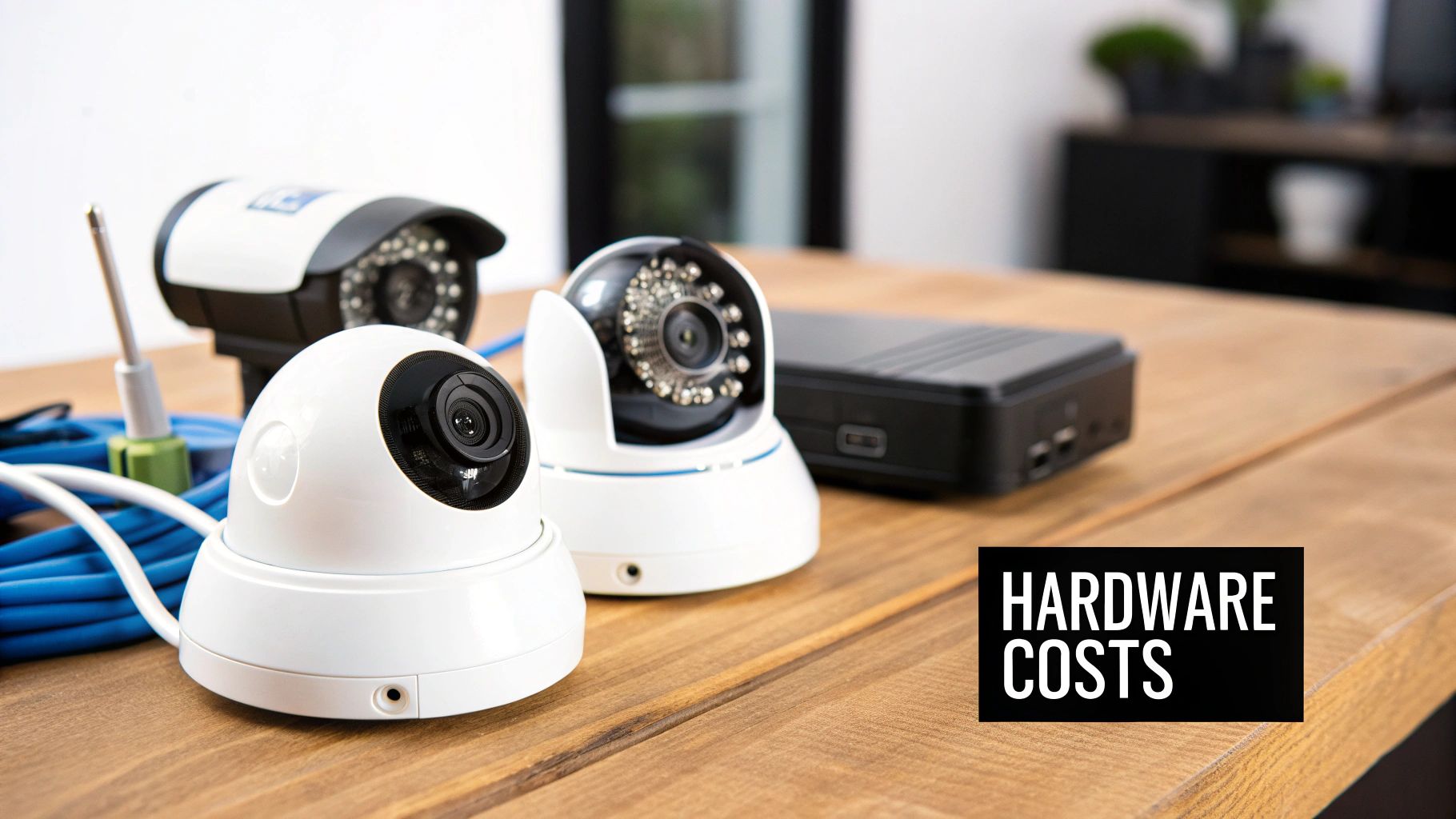
Let’s unpack the key pieces of kit you’re paying for and see how their specs affect the final bill.
Choosing the Right Cameras
Not all security cameras are made equal, and the price tag can swing wildly depending on what you need it to do. A simple indoor dome camera might run you about £150, but a high-spec outdoor model with all the bells and whistles can easily top £800. The trick is to match the camera to the job at hand.
- Dome Cameras: These are your go-to for indoor spaces like offices or retail shops. They’re discreet, and their design makes it tough for people to know exactly where the lens is pointing – a simple but effective deterrent.
- Bullet Cameras: Highly visible and unmistakable, these are perfect for monitoring specific outdoor spots like loading bays, car parks, or building entrances. They’re built to withstand the elements.
- PTZ (Pan-Tilt-Zoom) Cameras: These are the most capable and, naturally, the most expensive. A single PTZ camera can do the work of several static ones, covering huge areas like a warehouse floor or a construction site perimeter. An operator can actively pan, tilt, and zoom in to follow activity in real-time.
Beyond the physical shape, it’s the features inside that really drive the cost. A camera with 4K resolution will cost more than a standard 1080p model, but that extra detail is what allows you to clearly identify faces or read number plates. Likewise, infrared (IR) night vision is a must for 24/7 surveillance, and an IP67 weatherproof rating is non-negotiable for any camera facing the unpredictable Hampshire weather.
The System’s Brain: Recorders and Storage
If the cameras are your system’s eyes, the recorder is its brain and memory. It takes in all the video feeds and stores them safely for you to review later. Your main choice here will be between a Digital Video Recorder (DVR) for analogue systems and a more modern Network Video Recorder (NVR) for IP cameras.
The biggest cost driver for a recorder is storage capacity. How long do you need to keep your footage? 30, 60, or 90 days? This decision directly impacts the size and cost of the hard drives required.
A classic mistake is trying to save money by underestimating storage. If an incident occurs and you discover it a month later, but your system only stores footage for 28 days, your investment is rendered useless. It’s vital to get professional advice to match your storage to your real-world operational and legal needs.
For a medium-sized business running 16 high-quality cameras, a powerful NVR with plenty of storage can easily be one of the most significant parts of the hardware budget. Skimping here is a false economy that can come back to bite you.
Overlooked but Vital: Cabling and Infrastructure
Finally, your hardware cost includes the less exciting but absolutely critical components that make everything work together seamlessly. This is the connective tissue of your security network, and it’s where quality really counts.
- Cabling: Using professional-grade cabling, like Cat6 for modern IP systems, ensures a stable, clear signal. Cheaper cables are a common point of failure and can degrade your video quality over time.
- Power Supplies: Your cameras need clean, consistent power to function. A dedicated Power over Ethernet (PoE) switch is a smart move. It simplifies the wiring by sending both data and power through a single cable and, crucially, protects your expensive cameras from damaging power surges.
- Mounts and Housings: The right brackets and housings do more than just hold a camera in place. They ensure it’s positioned for the perfect viewing angle and protected from both the weather and potential tampering.
Investing in quality infrastructure from the start is the best way to prevent the common headaches that plague cheaper, DIY systems. It guarantees that the cameras you’ve invested in can do their job without a hitch, protecting your business around the clock.
Understanding Installation and Site Complexity Costs
Ever wondered why two quotes for the exact same eight-camera system can come back with wildly different price tags? The answer, almost every time, is the installation. While the cost of the hardware itself is fairly consistent, the labour involved in fitting it properly is where the biggest variables in your commercial CCTV system cost hide.
Think of it this way: you can buy the best ingredients, but you still need a skilled chef to turn them into a great meal. Professional installation is that skilled craftsmanship. It’s not just about screwing a camera to a wall; it’s about strategic placement, running cables discreetly and securely, and fine-tuning the whole system to work flawlessly. This is where the unique character of your building takes centre stage.
How Installers Calculate Labour Costs
Professionals don’t just pull a number out of thin air. Labour is carefully calculated based on the estimated time and complexity of the job. You might see baseline figures of £80 to over £200 per camera, but it’s crucial to see this as just a starting point.
The real cost comes down to the specific challenges your site presents. The goal is always to get the system installed with the least possible disruption to your business, while ensuring every cable is safe and every camera angle is perfect. That level of care takes planning and precision, and that’s what you’re paying for.
Key Factors Driving Installation Complexity
Every building has its own story and its own quirks. A good installer will spot these during a site survey, which allows them to give you a quote that won’t come with nasty surprises later.
- Building Materials and Age: Running a cable through a modern office with its plasterboard walls and suspended ceilings is one thing. It’s a completely different challenge trying to drill through the solid stone of a historic building in Hampshire or navigate the reinforced concrete of an industrial unit. The latter requires specialist tools, more time, and a lot more care.
- Site Size and Layout: It stands to reason that a sprawling warehouse or a multi-storey office block will need much longer cable runs than a compact high-street shop. This doesn’t just add to the material costs for the cable itself, but also significantly increases the time it takes to run and conceal it all neatly.
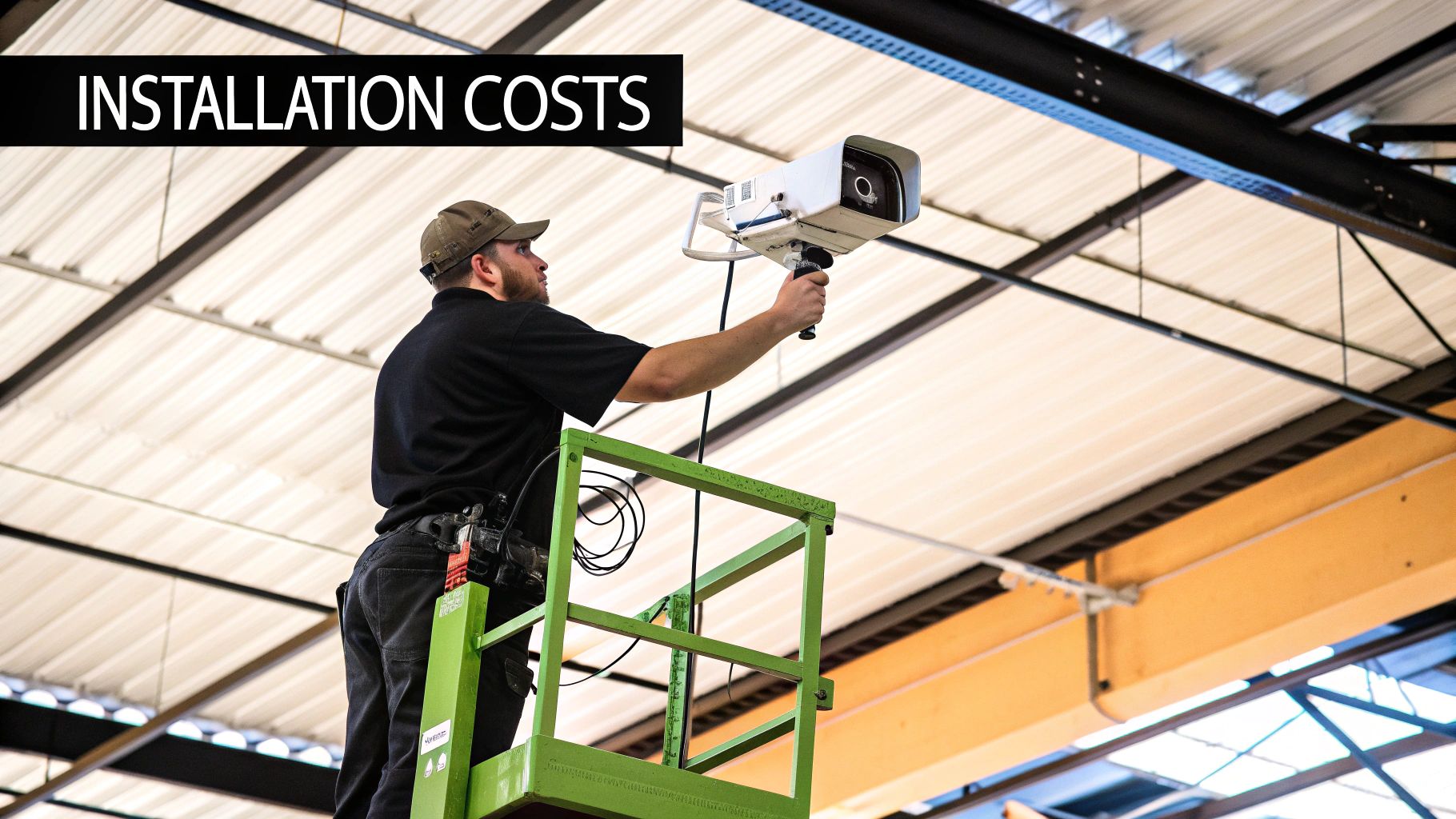
- Accessibility and Height: Mounting a camera on a ground-floor ceiling is straightforward. But what about one on a high warehouse ceiling, an external wall three storeys up, or tucked away in a hard-to-reach corner? These situations often call for specialist equipment like scissor lifts or scaffolding, which naturally adds to the project’s cost.
The sheer difference in installation complexity is the main reason why any “one-size-fits-all” quote you see online is rarely accurate. A proper on-site assessment is the only way to get a true picture of the work involved and a realistic cost.
For instance, a mid-sized commercial CCTV system in the UK, say for 8-16 cameras, might cost between £3,500 and £8,000 fully installed. The labour portion of that could easily be anywhere from £600 to £1,500, especially if the job involves tricky ceiling voids or upgrades to the power supply. For more on UK installation costs, Birmingham Control Centre’s 2025 breakdown offers some great insights.
Real-World Installation Examples
To really bring this to life, let’s compare two different scenarios for an identical eight-camera system.
Scenario A: The Modern Office Unit
- Building: A new-build office on a Southampton business park.
- Challenges: Very few. It has suspended ceilings for easy access and standard stud walls. Every camera position can be reached with a simple ladder.
- Estimated Labour: 8-10 hours. A smooth, predictable job.
Scenario B: The Historic High Street Shop
- Building: A Grade II listed retail property in the heart of Winchester.
- Challenges: Plenty. The exterior walls are thick, solid stone, needing careful, heavy-duty drilling. The interior has original features that can’t be disturbed, so cables must be routed the long way around. Two of the external cameras are high up, demanding a scissor lift for safe access.
- Estimated Labour: 20-25 hours. The project is far more complex, requires on-the-spot problem-solving, and involves hiring extra equipment.
As you can see, even though the camera hardware is the same, the labour for Scenario B could easily cost twice as much as Scenario A. This is precisely why it’s so important to understand the complexities of your own site when budgeting for your security.
Planning for Ongoing Monitoring and Maintenance
A security system isn’t a one-time purchase; it’s an ongoing commitment to keeping your business safe. The initial price for hardware and installation is just the start of the story. To get a true handle on your commercial cctv system cost, you have to factor in the recurring expenses that keep everything running effectively, month after month.
Think of it like a company vehicle. You wouldn’t buy a delivery van and then skip paying for fuel, insurance, or its annual service. Ongoing monitoring and maintenance are the essential running costs that ensure your security investment continues to protect your premises, especially when you need it most.
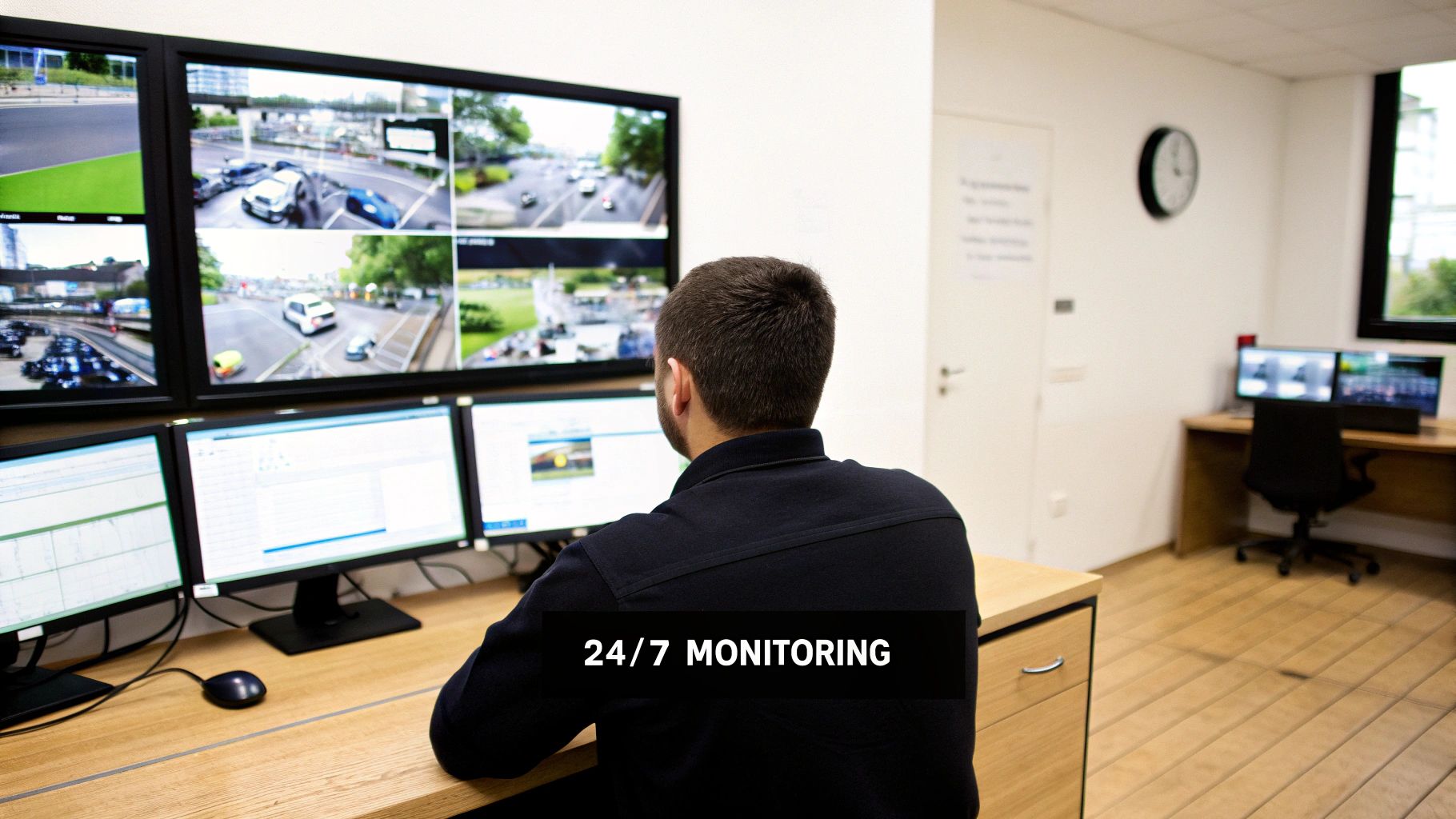
This proactive approach doesn’t just keep the system ticking over; it guarantees your security measures are ready to perform the second they’re needed.
Choosing Your Monitoring Approach
Once your cameras are up and running, you have a critical decision to make: how will alerts be handled? This choice directly impacts both your monthly budget and how effectively you can respond in an emergency.
- Self-Monitoring: This is the most basic route, where alerts from your system pop up on your smartphone. While it usually avoids monthly fees, it puts the entire burden of response squarely on you or your staff, 24/7.
- Professional Remote Monitoring: This is where a dedicated team of security professionals in a control room watches over your property. For a monthly fee, these experts can verify threats in real-time and, crucially, dispatch the police or our own mobile patrol units immediately. The response is far faster and more effective than a self-monitored alert.
For most businesses, the value of professional monitoring is undeniable. It means every critical alert is assessed and acted upon by trained experts, day or night. This active surveillance is a powerful deterrent and is absolutely key to stopping incidents as they happen.
The Importance of Maintenance Contracts
Just like any bit of tech, a CCTV system needs regular upkeep to perform at its best. A maintenance contract, often called a Service Level Agreement (SLA), is your insurance policy against unexpected failures and a slow decline in performance. It’s a small, predictable cost that prevents much larger, unforeseen expenses down the line.
A maintenance plan isn’t an upsell; it’s a fundamental part of ensuring your system is reliable and lasts for years. Without it, you risk a camera failing or footage being unusable right when you need it most.
A good SLA from a provider like Executive Securities Personnel Ltd will typically include:
- Regular System Health Checks: At least once a year, an engineer will visit to physically inspect and clean all cameras, check cable connections, and make sure your recording settings are spot on.
- Software and Firmware Updates: Keeping your system’s software up-to-date is vital for patching security weak spots and ensuring smooth operation.
- Priority Call-Outs: If an issue does crop up, an SLA ensures you get a rapid response from an engineer, minimising any security downtime.
This kind of proactive care keeps your system running smoothly and extends the life of your hardware.
Factoring in Cloud Storage Costs
A modern alternative to relying solely on a physical on-site recorder (like an NVR or DVR) is cloud storage. This service securely stores your video footage on remote servers, which has some serious advantages. For one, it makes your footage immune to on-site theft or damage to the recorder, and it provides easy, secure access from anywhere.
Of course, this convenience comes with a recurring subscription fee, usually charged per camera. This monthly cost is an important part of the long-term commercial CCTV system cost. It’s a trade-off between the upfront cost of a large physical recorder and the ongoing flexibility and security you get with the cloud.
For large-scale operations, like warehouses with over 64 cameras, the initial installation can range from £25,000 to over £50,000. The annual maintenance for a system of this scale can span from £100 to £2,000. In these environments, professional remote monitoring is a key trend, often replacing the high cost of on-site guards and cutting overall security spending by 40-60%. This is a vital consideration, given the number of business premises affected by crime each year. You can explore more about these market trends on Grand View Research.
Calculating Your Return on Investment
Justifying a big spend like a new CCTV system means we need to shift the conversation away from cost and towards value. The real worth of your security isn’t just a line item on a spreadsheet; it’s a smart investment that delivers a tangible Return on Investment (ROI). This return shows up in many ways, from thefts you stop in their tracks to wider operational gains.
Looking at the ROI helps you frame the commercial CCTV system cost as a strategic business decision, not just a grudge purchase. It’s about seeing the full financial picture—both the direct savings and the risks you’re taking off the table.
Tangible Financial Returns
The most straightforward way to see your ROI is to look at the hard numbers. We’re talking about measurable savings and recoveries that a professional security system makes possible, often within the first year.
Here’s where you’ll see the most immediate impact:
- Reduced Theft and Shrinkage: This is the big one. A good system deters both opportunistic shoplifters and internal employee theft. When something does happen, clear footage is your best friend for identifying who was involved and getting your property back.
- Lower Insurance Premiums: Many UK business insurers breathe a sigh of relief when they see a professionally installed and monitored CCTV system. They see you as a lower risk, and that often translates into a welcome discount on your premiums.
- Defeating Fraudulent Claims: Bogus “slip-and-fall” claims can be a nightmare, costing a fortune in legal fees and payouts. High-definition footage doesn’t lie, providing the indisputable evidence you need to shut down fraudulent personal injury claims before they gather steam.
Over time, these direct savings can easily cover a huge chunk of the initial system cost, proving the investment was a financially sound one.
A professionally installed CCTV system is far more than just a deterrent. It’s an evidence-gathering tool that protects your bottom line from theft, fraud, and unnecessary insurance hikes, turning a security expense into a quantifiable asset.
Intangible Benefits with Real-World Value
Beyond the money you save directly, a CCTV system delivers powerful benefits that are harder to stick a price tag on but are just as crucial for a healthy business. These ‘softer’ returns create a safer, more productive, and more trusted environment for everyone involved.
Think about the knock-on effect on your day-to-day operations. When staff see visible security, it shows them you’re serious about their safety, which is a real morale booster. A team that feels safe is often a more productive and loyal one.
It also works wonders for customer confidence. When people feel safe in your car park, your shop, or your reception area, they’re more likely to come back. For any business in Hampshire, building that positive local reputation is priceless.
Staying Compliant and Avoiding Eye-Watering Fines
A massive, and often overlooked, part of your system’s value is keeping you on the right side of the law. If you operate commercial CCTV in the UK, you have to comply with the Data Protection Act and UK GDPR. Getting this wrong can lead to fines that would make the cost of the system itself look like pocket change.
Key compliance steps you absolutely must get right include:
- Displaying clear, visible signs letting people know they are being recorded.
- Having a legitimate, documented reason for recording in each specific area.
- Storing the footage securely and restricting access to authorised personnel only.
- Having a policy for deleting footage when it’s no longer needed.
Working with a professional installer like Executive Securities Personnel Ltd is the simplest way to ensure you are compliant from day one. We live and breathe the legal framework and will design a system that ticks every box, protecting you from crippling fines and giving you complete peace of mind.
Finding the Right Security Partner in Hampshire
Getting a handle on the costs involved in a commercial CCTV system is one thing. But the most important decision you’ll make is choosing the right team to design, install, and look after it. For businesses in Southampton and right across Hampshire, partnering with a local specialist makes a world of difference.
Think about it: when a security problem pops up, you need a fix immediately, not in a few days. Because we’re based right here in Hampshire, our engineers can get to your site fast. This means less downtime for you and ensures your property is never left vulnerable. We also have a real feel for the local security landscape, whether that’s protecting an isolated rural business or a bustling city-centre shop.
A Tailored System, Not an Off-the-Shelf Box
We just don’t do generic, one-size-fits-all packages. Every business is different, so your security should be too. Our process always starts with a thorough, no-obligation risk assessment at your site. It’s the only way for us to properly understand how you operate, spot the weak points, and work within your budget.
This hands-on survey is the blueprint for everything that follows. We’ll walk you through our thinking, explaining exactly why we’re recommending a specific camera for your car park or how much recording storage you’ll actually need to stay compliant. The aim is to give you maximum protection without wasting a penny on features you don’t need.
Choosing a security partner is about more than just cameras and cables; it’s about trust. A local team that takes the time to properly understand your business will always deliver a better, more effective solution than a faceless national company.
By starting with this detailed assessment, we make sure the quote you get is accurate and easy to understand, with no nasty surprises down the line.
Ready to protect your business with a system designed from the ground up for your needs? The team at Executive Securities Personnel Ltd is here to help. Get in touch today to book your free, in-depth site survey and we’ll put together a detailed quote for your Hampshire business.
Your Commercial CCTV Questions Answered
When it comes to pricing up a new commercial CCTV system, it’s natural to have questions. We get it. Making a smart investment means getting straight answers, and this is where our experience helping businesses across Hampshire really comes in. Here are a few of the most common queries we hear.
How Long Will a Commercial CCTV System Actually Last?
A professionally installed system is built to be a long-term asset, not a short-term fix. You should realistically expect the main hardware—your cameras and recorders (NVRs/DVRs)—to give you 5 to 10 years of solid service.
But that’s not a hard and fast rule. Two things make all the difference. First is the quality of the kit you install from day one. Choosing proper commercial-grade equipment is the foundation for a system that lasts. The second, and just as important, is regular maintenance. Think of it like a car’s MOT; a yearly service check keeps everything running smoothly, extends its life, and flags up small issues before they become big problems. We usually find it makes sense to upgrade when new tech offers a genuine leap forward (like new AI analytics), or when older parts simply become obsolete.
Can I Save a Few Quid by Installing It Myself?
The thought of cutting out installation costs is tempting, but for a business, this is one corner you really shouldn’t cut. A commercial setup is a different beast entirely from a plug-and-play home camera. It requires careful planning to make sure you’re covering every angle and weak spot.
A poorly installed CCTV system is often worse than having no system at all. It gives you a false sense of security while leaving you wide open to theft, liability claims, and even hefty fines.
Going the DIY route can create some serious headaches:
- Critical Blind Spots: It takes a trained eye to spot the weak points in a building’s layout. It’s incredibly easy to misplace a camera, leaving a perfect gap for an intruder to slip through unseen.
- Falling Foul of the Law: UK businesses have to follow strict data protection rules (UK GDPR). A professional installer makes sure everything from your signage to how you store footage is above board, saving you from a potential fine.
- Problems with Your Insurance: Many business insurance policies specify that security systems must be professionally installed and maintained. A DIY job could give them a reason to reject a claim just when you need the cover most.
- No One to Call When It Goes Wrong: If a system you’ve installed yourself fails, it’s on you to figure it out. With a professional partner, you have expert support and engineers ready to get you back up and running.
Are Wireless Cameras a Cheaper Option for My Business?
Wireless systems can look like an attractive, lower-cost option on the surface, mainly because they cut down on the time and labour needed to run cables. However, the hardware itself—the actual commercial-grade wireless cameras—is often more expensive than the wired equivalent, which can quickly eat into any initial savings.
The real decider for businesses, though, is reliability. Commercial spaces like warehouses, large shops, or industrial units in Southampton are often full of things that interfere with wireless signals, from steel beams and machinery to other networks. This can cause the connection to drop out, meaning you lose footage right when you might need it most. A traditional wired system provides a far more stable, dependable connection. A proper site survey is the only way to know for sure if a wireless or hybrid system is a genuinely workable option for your premises.
Ready to get clear, honest answers and a security plan that fits your business perfectly? At Executive Securities Personnel Ltd, we start with a detailed on-site assessment to design a system that protects your assets and meets your budget. Request your free, no-obligation security quote today.