

Choosing the right security partner in Southampton isn’t just a tick-box exercise; it’s a fundamental decision that protects your assets, your team, and your ability to trade without disruption. Think of it less as a cost and more as a strategic investment in your business’s stability. This guide will walk you through how to find a firm that offers genuine peace of mind.
What’s Happening on the Ground in Southampton?
Before you can secure your business, you need to understand the local environment. Southampton is a fantastic, bustling city, but like any major hub, it has specific security challenges that can leave commercial properties exposed if they aren’t properly protected.
What’s really telling is the local attitude towards security. A revealing study found that Southampton is the third least security-conscious place to live in the UK. Researchers noted a significant gap between crime rates and the security measures people put in place, with bicycle theft, for instance, soaring at 166% of the national average. You can dig into the specifics in the full study on UK security consciousness.
This casual approach to security can unfortunately create an environment where criminals see local businesses as soft targets. They might gamble that a commercial site has the same relaxed attitude, which makes a professional, visible security presence a powerful and essential deterrent.
Why This Local Insight Is Crucial for Your Business
This isn’t just an interesting statistic; it directly influences your security needs. A highly visible security detail does more than just protect your property—it sends an unambiguous signal that your business is not an easy mark. This is precisely where professional security companies southampton prove their worth.
A dedicated security partner can immediately address these local risks by:
- Acting as a Powerful Deterrent: The simple sight of uniformed guards and clearly marked patrol vehicles makes opportunistic criminals think twice. It disrupts their assumption that yours is an easy target.
- Spotting Problems Before They Happen: Trained professionals see things others miss. Their patrols can identify vulnerabilities like a broken fence, a poorly lit corner, or an unsecured gate that could become a serious problem.
- Responding Instantly: When an alarm sounds or an incident occurs, a local security team can be on-site far quicker than the police, often resolving the issue before it escalates.
- Providing Specialist Skills: Every business is different. A construction site needs a different approach than a retail park. A good security firm provides specific strategies for your unique operational risks.
Key Takeaway: Hiring a security company isn’t just about getting guards on-site. It’s about implementing a proactive strategy that directly counters local crime trends to protect your reputation, your assets, and your bottom line.
In short, getting security right in Southampton means being proactive. Understanding the local picture is the first step in building a defence that works. By bringing in a reputable firm, you turn potential weak spots into strengths, ensuring your business can operate smoothly, no matter what’s happening outside your gates. Let’s explore how to find that perfect partner.
Before you even think about comparing quotes or talking services, there’s a crucial first step you absolutely cannot afford to skip: checking a security company’s credentials. This isn’t just about ticking a box. It’s about protecting your business from serious legal and financial blowback.
Imagine the worst happens. An incident occurs on your premises involving a security guard, and you later find out the company you hired wasn’t properly insured or licensed. The liability could fall directly on you, turning what was supposed to be a security measure into a massive financial headache.
This is why getting the fundamentals right from the start is so important.
The SIA Licence Is Your First Line of Defence
In the UK, the private security industry is regulated by the Security Industry Authority (SIA). It’s a legal requirement for anyone working in most security roles to hold a valid front-line SIA licence. It’s also illegal for a company to supply unlicensed guards. Simple as that.
This is the first and most critical check you need to make. Any professional security firm in Southampton will not only hold its own SIA licence but will also ensure every single officer they send to your site is individually licensed and fully compliant.
- Don’t just take their word for it. Ask for the SIA licence numbers for both the company and the guards assigned to you.
- Do your own check. You can easily verify any licence using the official SIA Register of Licence Holders online. A good company will expect and respect this level of due diligence.
Making this simple check will instantly weed out the cowboys and unqualified operators.
Are They Properly Insured? Your Financial Safety Net
What happens if an officer is injured on your site, or an incident leads to damage to a third party’s property? Without the right insurance, the financial responsibility could land squarely on your business.
You need to see proof of two essential policies:
- Public Liability Insurance: This is vital. It covers claims if a member of the public is injured or their property is damaged. For a professional security firm, you should be looking for a minimum coverage of £5 million.
- Employers’ Liability Insurance: A legal must-have for any UK business with staff, this covers claims from their own employees if they are injured or fall ill because of their work.
Always ask to see their current insurance certificates. Pay close attention to the coverage amounts and, crucially, the expiry dates. Any reluctance to share these documents is a massive red flag.
Vetting and Screening: Who Are You Really Hiring?
You need to know that the people tasked with protecting your assets are genuinely trustworthy. This is where professional vetting comes in, and the industry benchmark is BS7858 (Screening of Individuals Working in a Secure Environment).
This British Standard isn’t just a quick background check. It’s a comprehensive screening process that dives deep into a person’s history, including identity verification, a full five-year employment history check, financial probity, and criminal record checks. It’s the gold standard for security recruitment.
When a company like Executive Securities adheres to BS7858, it tells you they have a serious, structured process for hiring dependable and thoroughly vetted staff. It’s a clear sign of their commitment to quality, ensuring the guards protecting your Southampton site are people you can truly count on.
To make it easier, here’s a quick-reference table of the absolute essentials you need to verify before signing any contract.
Essential Security Credential Checklist
| Credential | What to Look For | Why It Matters |
|---|---|---|
| SIA Licensing | Company licence and individual officer licences. Verify numbers on the official SIA register. | It’s a legal requirement. Hiring an unlicensed firm or guard is illegal and exposes you to huge risk. |
| Public Liability Insurance | A current certificate showing at least £5 million in coverage. | Protects you from financial liability if a member of the public is injured or their property is damaged. |
| Employers’ Liability Insurance | A current certificate confirming they hold this legally required insurance for their staff. | Ensures their employees are covered, preventing potential claims from being redirected to you. |
| BS7858 Vetting | Confirmation that they screen all security personnel to this British Standard. | Guarantees that the people on your site have undergone rigorous background and character checks. |
Treat this checklist as non-negotiable. A professional and reliable security partner will have all this information ready and will be happy to provide it. If they can’t, it’s best to walk away.
Matching Security Services to Your Business Needs
There’s no such thing as a one-size-fits-all security plan. The real secret to effective, affordable protection is to pinpoint your specific risks and choose the services that tackle them head-on. Before you can build a smart strategy, you need to get to grips with what security companies in Southampton can actually offer.
It’s about more than just sticking a guard on a gate; it’s about deploying the right people and technology where they’ll make the biggest difference. The UK’s private security sector has ballooned to a market size of £8.9 billion for a simple reason: businesses need specialised solutions. The ever-growing demand for proper manned guarding and CCTV monitoring shows that companies are moving beyond basic, tick-box security. You can find out more about the growth of the UK’s private security industry on ibisworld.com.
Before you get lost in the details of different services, this flowchart covers the absolute essentials you must check first.
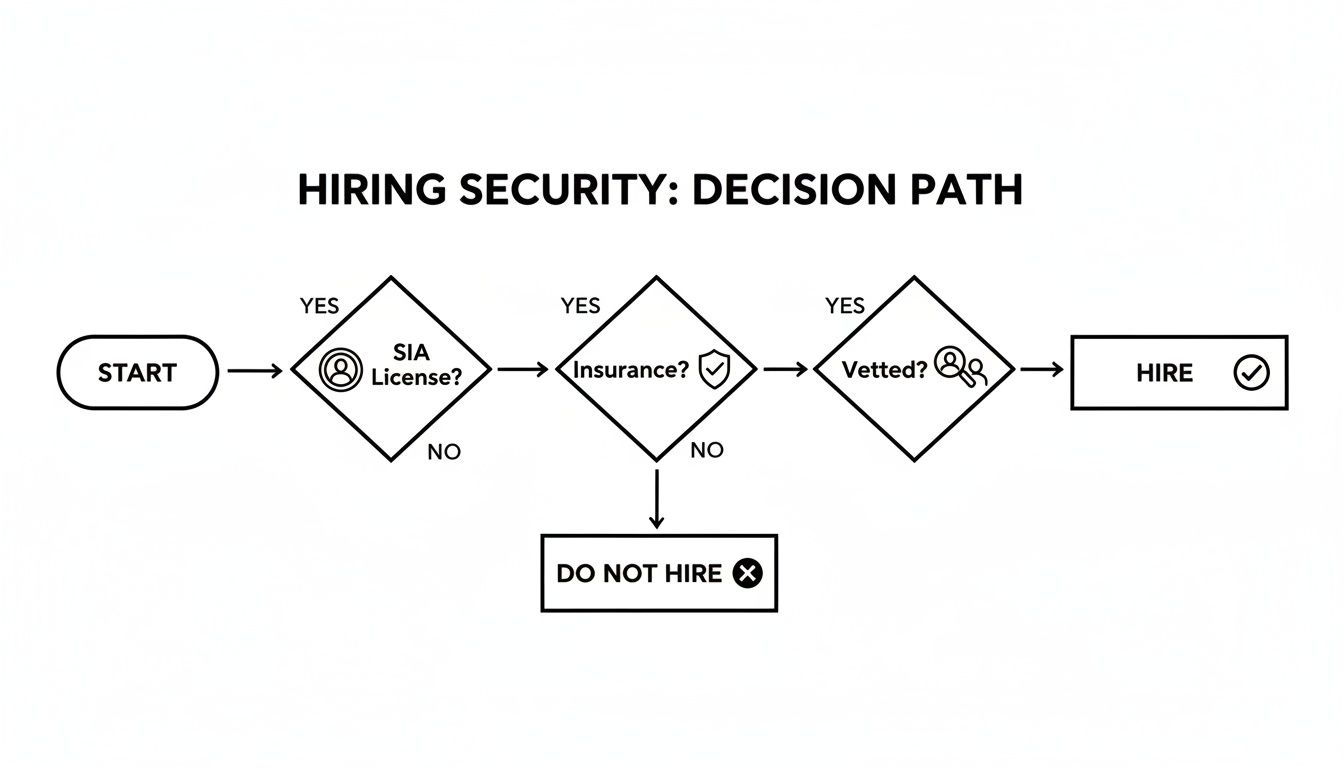
Think of this as your foundation. Getting SIA licensing, insurance, and vetting right is non-negotiable. Only then should you start matching services to your specific site.
Mobile Patrols: A Smart, Cost-Effective Deterrent
What if you don’t need a guard on-site 24/7? For many businesses, mobile security patrols strike the perfect balance between a visible presence and good value. They’re brilliant for covering large areas or keeping an eye on multiple locations.
Take a sprawling industrial estate in the Millbrook area, for example. One static guard would be stretched thin trying to cover the entire perimeter. A mobile patrol, however, can sweep through in a marked vehicle, conducting regular but deliberately randomised checks all night long.
These patrols are a great fit for:
- Industrial Parks & Logistics Hubs: A clear deterrent across dozens of units and multiple access points.
- Vacant Commercial Properties: Keep the site secure from squatters or vandals without the expense of a full-time guard.
- Retail Parks After Hours: A quick and efficient way to check that every storefront is locked down and to respond to any alarms.
The real advantage here is the element of surprise. Potential thieves can’t time their approach when they have no idea when the next patrol will arrive, making your site a far harder target.
When a Static Guard is Non-Negotiable
For higher-risk locations or sites buzzing with constant activity, a static security guard is absolutely essential. They offer a constant, fixed-point presence, giving you complete control over who comes and goes while being able to react instantly to any problems.
Think of a major construction project near Ocean Village, with millions of pounds of equipment and materials just sitting there. The risk of theft is sky-high. Here, a static guard is crucial for managing contractor access, logging deliveries, and stopping unauthorised people from wandering on-site, day or night.
At Executive Securities, we make sure our static guards become an active part of your operational team. They aren’t just there to stand around. They handle gatehouse duties, perform regular foot patrols, and provide you with detailed daily incident reports, fitting seamlessly into your site management.
Upping the Ante with K9 Units and Modern CCTV
Sometimes, you need a stronger deterrent or a better pair of eyes. This is where specialist services like K9 security units and advanced CCTV systems can turn your security from reactive to proactive.
A K9 security unit is an unmatched deterrent for big, open sites like storage yards or solar farms. A dog’s incredible sense of smell and hearing means it can detect an intruder long before a human guard ever could. For perimeter security, they’re in a league of their own.
At the same time, a professionally designed CCTV system linked to remote monitoring creates a powerful surveillance network. Imagine you’re a retail manager in Southampton. You could have a static guard during the day, then switch to a remote monitoring service at night. If the system’s smart analytics flag suspicious movement, an operator can immediately issue an audio warning through a speaker and dispatch a mobile response team. It’s an integrated approach that gives you solid, 24/7 protection, often stopping a crime before it even starts.
How to Analyse Quotes and Contracts
Getting the quotes in feels like the last step, but this is where the real work begins. You’ll quickly see that not all quotes are created equal, and the cheapest price can often hide the biggest risks.
An unusually low bid should be a red flag. What corners are they cutting to get that price down? Are they skimping on proper insurance or using guards who aren’t fully SIA licensed? A price that seems too good to be true almost always is, and it could leave you with poorly trained staff and a whole load of liability.
What to Look for in a Quote
Any reputable security company in Southampton will provide a transparent, detailed quote. You should be able to see exactly what you’re paying for.
Look for a clear breakdown of:
- Hourly Rates: Are they broken down by shift type (e.g., weekdays, nights, weekends)?
- Total Service Hours: The total coverage hours per week or month should be clearly stated.
- Extra Costs: Are there hidden charges for things like patrol vehicles, reporting software, or even uniforms?
If a quote just gives you a single number with no detail, don’t accept it. Push back and ask for a proper breakdown. It’s the only way to compare apples with apples.
Reading the Fine Print: Your Contract
Once the numbers look right, it’s time to focus on the contract. This document is more than just a formality; it’s the legal foundation of your entire relationship with the security provider. It pays to read it carefully before signing anything.
Don’t just skim it. The small print is where the crucial details live. A well-written contract protects both you and the security firm, setting clear expectations right from the start.
Key Insight: Think of your contract as the operational rulebook. It defines everything from alarm response times and liability to how you part ways if the relationship doesn’t work out. A vague contract is a sure sign of an unprofessional outfit.
A few key areas in the contract deserve your full attention. Getting these right will save you a lot of potential headaches down the line.
Must-Check Contract Clauses
Before you commit, make sure you’re completely clear on these terms.
- Agreement Length and Termination: How long is the contract for? What’s the process if you need to end it early? You should be looking for a reasonable notice period, usually 30-90 days, that doesn’t hit you with unfair penalties.
- Liability Limits: This clause spells out what the security company is financially responsible for if things go wrong. Check that this figure aligns with their insurance coverage and doesn’t leave your business exposed.
- Service Level Agreements (SLAs): This might be the most important section of all. The SLA defines the specific, measurable performance standards the company is contractually obligated to meet.
An SLA for a Southampton business, for example, might guarantee an alarm response time of under 20 minutes. Or it could commit to a minimum of eight random mobile patrols during a 12-hour shift. These aren’t just verbal promises; they’re binding commitments.
The South East is a crowded market for security, with 1,675 security enterprises operating in the region—second only to London. That competition gives you the power to find fair pricing and a fair contract. You can see more data on the UK’s security sector via Statista. Take the time to find a partner who offers a transparent, fair agreement that truly protects your interests.
Key Questions to Ask Potential Security Providers

Alright, you’ve checked their licences and confirmed they offer the services you need. Now comes the most critical part: separating the truly professional security partners from those who just talk a good game.
This is where you dig into the nitty-gritty of how they actually operate. Think of it less like a sales pitch and more like a job interview for a crucial role in your business. Their answers—or lack of them—will reveal everything about their reliability, their company culture, and how they’ll perform when it really matters. A confident, straight answer is a very good sign.
Understanding Their Staffing and Training
The effectiveness of any security plan comes down to the people on the ground. A security company that invests properly in its team is, by extension, investing in your safety. It’s that simple. High staff turnover is a huge red flag, often pointing to poor management or conditions that won’t attract top-tier professionals.
Get right to the point and ask them:
- What is your staff turnover rate? A low rate, ideally under 15%, points to a stable, experienced team. If they have a revolving door of staff, you’ll constantly have new, unfamiliar faces who don’t know the specifics of your site.
- Beyond the basic SIA licence, what ongoing training do your officers receive? Look for answers that go beyond the bare minimum. You want to hear about regular training in conflict de-escalation, advanced first aid, customer service, and even fire safety. This shows they’re committed to developing genuine security professionals.
These questions cut through the sales talk. They tell you whether a company sees its officers as skilled assets or just bodies to fill a uniform.
How They Manage Operations
Flawless execution is what you’re paying for. You need absolute confidence that patrols are being done correctly, incidents are handled by the book, and technology is used to its full potential. This is where you test their operational backbone.
Any professional security firm should be able to walk you through their standard procedures without missing a beat. If you get vague answers about “making sure things get done,” that’s your cue to be sceptical. You need to hear about the systems, not just the promises.
Probe their day-to-day processes with questions like these:
- How do you actually monitor patrols to prove rounds are completed? A solid answer will involve GPS tracking, electronic checkpoint systems (often called ‘tagging’), or live reporting software. This technology doesn’t just keep guards accountable; it gives you a verifiable audit trail.
- Walk me through your standard procedure for a break-in. They should instantly be able to describe a clear chain of command: the officer’s immediate site assessment, contacting the police or fire brigade, securing the scene, and notifying you immediately.
Focusing on Client Relations and Reporting
Finally, let’s talk about you. How will they communicate and build a working relationship? Clear, timely reporting and a consistent point of contact are non-negotiable. Without them, you’ll be chasing down information precisely when you need it most.
Consider asking:
- What does a typical incident report from you look like? You should expect to see detailed digital reports, complete with timestamps and photographic evidence, sent to you promptly after any event.
- Who is my day-to-day point of contact? Having a dedicated account manager or a familiar operations supervisor makes life so much easier. It ensures someone who understands your site is always accountable.
By asking these sharp, focused questions, you’ll have all the information you need to properly evaluate the different security companies in Southampton and make a choice you can trust.
Your Questions Answered
When you’re looking to hire a security company in Southampton, a few key questions always come up. Here’s some straightforward advice based on our years of experience in the local area.
How Much Should I Expect to Pay for Security in Southampton?
This is the big one, but the honest answer is: it depends entirely on what you need. A simple mobile patrol, where a guard checks your site a few times a night, might just be a small fee per visit.
On the other hand, if you need a dedicated, SIA-licensed static guard on-site around the clock, you could be looking at anything from £14 to £25+ per hour. Things like night shifts, specific risks at your location (like a construction site with valuable plant machinery), and the length of your contract will all play a part in the final figure. My best advice? Always get detailed, written quotes from at least three reputable local firms to get a true sense of the market rate.
What’s the Difference Between an SIA Licence and ACS Accreditation?
It’s crucial to understand this distinction. An SIA licence is the legal, mandatory qualification for any individual working in the security industry. If a guard doesn’t have one, they’re working illegally. Simple as that.
The ACS (Approved Contractor Scheme), however, is a voluntary benchmark for the company itself. It’s a rigorous, independent assessment of a firm’s operational standards, financial health, and quality management.
Choosing an ACS-accredited company gives you an extra layer of confidence. It tells you they’re not just meeting the bare minimum legal requirements but are actively committed to being one of the best in the business. It’s a powerful sign of a reliable, professional partner.
Can I Hire a Security Company for a One-Off Event?
Absolutely. Any good security firm will offer temporary services for things like corporate events, local festivals, or even private parties. They can handle everything from crowd management and access control to protecting valuable equipment for the day or weekend.
Just be sure to book well in advance, especially if your event is during a busy time of year. Getting the right team in place takes planning, and you want to ensure you have experienced staff available to make your event a safe and secure success.
For a security partner that combines deep local knowledge with the highest professional standards, get in touch with Executive Securities Personnel Ltd. See how we can protect your Southampton business by visiting us at https://www.executivesecurities.co.uk today.